Tuesday, September 28, 2021

Tues/ Wed, Sept 28/29 prejudice and Claude McKay's America


 In Class: Collect your notebooks
1. How does prejudice emerge? 

Nobody is born prejudice, yet throughout history, we continue to form opinions about people who look or act differently than we do.

Begin with a correct MLA heading:

Your name

Instructor's name

English-II-( ), America

27 September 2021

Respond to the following question in a complete, well-written sentence.

 1. How does prejudice emerge in a person or society?

(Be prepared to share)


Respond to the following question in two to three complete, well-written sentence.

2. What are the effects of prejudice? (consider customs, laws and institutions)

(Be prepared to share)


********************************************************************

Let's take a look at ourselves

Concepts That Numb the Brain

The effects of prejudice – what happens inside us, outside us, and all around us – when prejudice exists.

Hurtful Words

There are words in our vocabulary that disrespect and dehumanize people. Many are designed to put down certain groups. Using hurtful words is one way we let our prejudices show.

Conditioned Thoughts + Reinforced by Conditioned Feelings = Conditioned Re-Actions

Making Generalizations

Lazy thinking causes us to make generalizations about people without taking the time to find out the specifics of who they really are. Take a look at a few results of prejudiced thinking.

Sterotyping

A standardized mental picture held in common by members of a group, that represents an oversimplified opinion, attitude or judgment.

Test your prejudiced thinking by mentally filling in the blanks in your mind. Do not speak your thoughts aloud.

  • Westerners are ________
  • Northeasterners are ________
  • Southerners are ________
  • Northerners are ________
  • Foreigners are ________
  • Asians are ________
  • The Irish are ________
  • Mexicans are ___________
  • Jews are ________
  • Africans are ____________
  • Arabs are ______________
Did you notice any prejudiced thoughts? Write two to three sentences about what you noticed about your self.

Bigotry 

Refers to one who is strongly partial to one’s own group, belief system, race or politics, and is intolerant of those who are different.

A bigot has a fixed mindset, an immovable way of thinking that divides people. Bigots think in terms of “my group” vs. “your group.” As soon as we have “my” vs. “your” anything, we have conflict. Sectioning the human race into “different” parts creates separation and conflict.

In this life, we focus more on differences than similarities, and we need to change this.

*****************************************************************

WEDNESDAY, SEPTEMBER 29: Collect your notebooks.

The following is a continuation of your responses / reflections on prejudice.

 We are reading Claude McKay's sonnet America as a class. 

As you read, take note of the figurative language device of imagery. Think about how the five different senses are employed to give depth of thought and feeling to McKay's poem. 

Once we have reviewed the poem, please follow the instructions listed below to respond to the four questions that follow.


New York skyline 1920's

Guiding questions:

             What is the theme or central idea of Claude McKay's America?

              How does he feel about this city?

              What are clues in the poem that tell us how feels?

              This unit has to do with prejudice and discrimination. How is this relevant to this poem?

AMERICA

by Claude McKay

1921


Festus Claudius “Claude” McKay (1889-1948) was a Jamaican-American novelist and poet who played an important role in the Harlem Renaissance — a cultural, social, and artistic movement that took place in Harlem, New York. “America” was first published in The Liberator in 1921, in which the speaker discusses his or her feelings about America. 

 As you read, note the  use of the figurative language device of imagery* in this sonnet* that communicates the speaker's perspective on America. We will be reviewing the poem's imagery in class on Thursday.


* an English sonnet has 14 lines of 10 syllables per line

*imagery is the use of figurative language to represent the objects, ideas, and actions in such a way that the appeals to the physical sense.

Sensory imagery involves the use of descriptive language to create mental images. In literary terms, sensory imagery is a type of imagery; the difference is that sensory imagery works by engaging a reader’s five senses. Any description of sensory experience in writing can be considered sensory imagery.

Five types of imagery: (there are more, but this is what we are focusing on)

1. seeing or visual

2. hearing or auditory

3. smelling or olfactory

4.tasting or gustatory

5. feeling or sensory


1. Although she feeds me bread of bitterness,
And sinks into my throat her tiger’s tooth,
Stealing my breath of life, I will confess
I love this cultured hell that tests my youth.
5. Her vigor flows like tides into my blood,
Giving me strength erect against her hate,
Her bigness sweeps my being like a flood.
Yet, as a rebel fronts a king in state,
I stand within her walls with not a shred
10. Of terror, malice, not a word of jeer.
Darkly I gaze into the days ahead,
And see her might and granite wonders there,
Beneath the touch of Time’s unerring hand,
Like priceless treasures sinking in the sand.

***********************************

In your notebook, as a continuation of yesterday, please respond to the following guiding question. Weave in text using evidence from the poem (don't forget you quotation marks" to support your response. This needs only to be one or two sentences.

Your question:   What is the theme or central idea of Claude McKay's America?

Example of how to weave in the text: 

In response to the question of how McKay feels about the city:

McKay has mixed feelings about New York. While he "love[s] this cultured hell", the city "feeds [him] bread of bitterness."

Note that how you can change the word within the line. Just put your words into brackets.

Text-Dependent Questions Directions:

 For the following four questions, choose the best answer: In your notebook write:

number 1:                                                                                                              number 2:                                                                                                  number 3:                                                                                                             number 4:

                                        Question1_________________

1. PART A: Which of the following best describes the speaker’s feelings about America?

A. The speaker has experienced both good and bad things in America, and thus

remains indifferent.

B. The speaker despises America and has decided to speak out about their bad

experiences.

C. The speaker has a love-hate relationship with America, but ultimately has lost

faith in the country.

D. The speaker dislikes and has lost faith in America and believes that it will not last

as it is.


                                        Question 2______________________

2. PART B: Which of the following quotes best supports the answer to Part A?

A. “Although she feeds me bread of bitterness, / And sinks into my throat her

tiger’s tooth, / Stealing my breath of life, I will confess / I love this cultured hell

that tests my youth.” (Lines 1-4)

B. “Her vigor flows like tides into my blood, / Giving me strength erect against her

hate” (Lines 5-6)

C. “Yet, as a rebel fronts a king in state, / I stand within her walls with not a shred--

/ Of terror, malice, not a word of jeer.” (Lines 8-10)

D. “Darkly I gaze into the days ahead, / And see her might and granite wonders

there” (Lines 11-12)


                                     Question 3_____________________________


3. PART A: In line 11, the word “darkly” is most likely used to convey which of the following?

A. The word “darkly” conveys the speaker has an overall cynical opinion of America.

B. The word “darkly” conveys the speaker’s general fear of time.

C. The word “darkly” conveys the speaker’s uncertainty about the future of

America.

D. The word “darkly” conveys that the speaker does not actually know anything

about America.


                                   Question 4_________________________________

4. PART B: Which of the following phrases supports the answer to Part A?

A. “I gaze into the days ahead” (Line 11)

B. “might and granite wonders” (Line 12)

C. “the Touch of Time’s unerring hand” (Line 13)

D. “priceless treasures sinking in the sand” (Line 14)

Comments


Monday, September 27, 2021

Monday, September 27 denotation and connotation

  HousekeepingPease make sure you keep up with your assignments. If there is a ZERO, that means I did not receive the work.  Remember that we are using a class blog. You can always copy and paste work from the blog onto a google document and share with me. Don't forget to give sharing permission!

Remember that if you have an illegal absence, your work is considered late.

Missing work. You will see a zero as a holding place, until such time as you turn in your work for a maximum of 75 points.

Sharing: dorothy.parker@rcsdk12.org

IAssignments so far this year:

Grammar: fewer/ less

                 there, they're, their

                 than, then

Three quick writes:  "If Only" , Should One Fear Failure, What IS Your Most Loveable Quality?

About Me Slide

Point of View exercise

Serena Williams questions / vocabulary sentences

################################################

In class: 


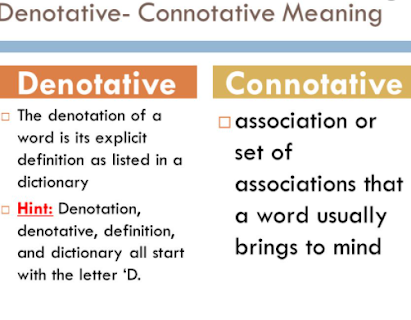
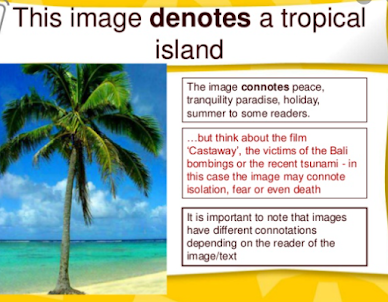
to denote-(verb)-what is indicated or signified
to connote (verb)-what is implied beyond the primary meaning of a word. 
                                     verb

noun


                             adjective


  1. Choose the correct word in each sentence below. 

    _____1. Hollywood (A.  B.  ) romance and glittering success.

    _____2. When politicians answer questions, hesitation may (A. connote) 
  2.  (B. denote) weakness or ignorance on a topic.

    ______3. A flashing yellow light on a highway (A. connotes) 
  3. (D. denotes) caution.

    _______4. The term skinny has a negative (A.connotation B. denotation ) while "slender" has a positive one.

    ______5. Fuel (A. connotes B. denotes ) a substance burned to produce heat or power.

    ______6. To some, the word school (A. connotes B. denotes ) confinement, but it may suggest intellectual excitement or sociability to others.

    _______7. The (A. connotative  B. denotative ) meanings of words are usually neutral.

    ______8. Both cheap and inexpensive (A. connotes  B. denotes ) something that has a low price.

    _______9. The word beach (A. connotes  B. denotes ) a sandy shore.

    _______10. Because the (A.connotation B. denotation)                 of pushy and assertive are quite different, the two words are not interchangeable.

    ______11. The word father1.  (A. connotes B. denotes ) affection.

  4. ______12. Solid (A. connotes B. denotes ) that something is neither gaseous nor liquid.

  5. ______13. The term liberal has taken on many (A. connotations B. denotations) in recent years.

    _______14. Pushy has a negative (A. connotation  B. denotation ) while assertive is usually positive.

  6. ______15. Red flares are used to (A. connote B.denote) danger.
*************************************************************
Independent Practice... class handout. If you are absent, you can simply highlight the following; then copy onto a google doc; then share directly with me, making sure to give me sharing permission. (address above).

For the italicized word, the denoted word, in each of the following  eight sentences,

give two potentially positive and two negative connotations. If there is an

unfamiliar word, look it up. See model                                                                

  1. I recognized the familiar smell of my roommate's cooking.


   delicious

     enticing


  Stinky

   nauseating


2.    2.   Scrapple is an inexpensive meal.


3. Kevin's interest in model cars has turned into a hobby.


4.      Uncle Henry lives in a hut deep in the woods.


5.      My parents are committed conservationists.


6.      My old laptop has finally died.


7.      The teacher was mildly intimidated by Roland's assertive behavior

8.       


9.      Phileas Fogg was an adventurous traveler.


Thursday, September 23, 2021

Thursday/Friday, September 23/24: Serena Williams Cat Suit Controversy

                          Afganistan Soccer Team


                                   Norwegian Volleyball Team


Thursday/ Friday.  We will be reading and discussing the following text in class.

1. Once we have reviewed the text, please highlight, copy and paste the 11 questions onto a google document. 

2.Highlight the correct response. Take your time; this is numerically graded. (Don't hesitate to go back to the original text)

THEN:

3. Look over the vocabulary words and

           for Honors classes: Select six of the vocabulary words and write a pithy sentence that clearly encapulates the meaning of the word.

            Sample: Getting tickets to the Roland Garros, also known as the Friench Open, is both a difficult and an expensive venture for this prestigious tennis competition.

           for Regents classes: Select four of the vocabulary words and write a pithy sentence that clearly encapsulates the meaning of the word.

                     Share your completed google document with:

dorothy.parker@rcsdk12.org

SERENA WILLIAMS’ CATSUIT CONTROVERSY EVOKES THE BATTLE OVER WOMEN WEARING SHORTS


Vocabulary: please take the time to familiarize yourself with these words prior to reading the text.

1. * controversy-noun   disagreement, typically when prolonged, public, and heated

2. * French Open- major tennis tounament held in Paris.

3. *scrutiny (noun) : critical observation or examination

4. * bifurcated (adjective): folded in two  (note that the prefix bi means 2) (You also saw this word in the description of the bifurcated bloomers from Tuesday.)

5. * to rankle (verb) : to cause persistent annoyance or resentment

6. * aesthetics (noun): relating to the beautiful

7. *the old guard: the original or long-standing members of a group who are reluctant to accept change 

8. *satorial: (adjective) relating to clothing or dress

In this informational text, Deirdre Clemente discusses the controversy* surrounding what Serena Williams, a famous tennis player, decided to wear to the 2018 French Open*. Clemente uses this example to explore the attention that female athletes’ outfits have received historically. 


*******************************************************************

At the French Open, Serena Williams wore a custom-made black catsuit. On Aug. 24, the president of the French Tennis Federation said the outfit “wouldn’t be back.” It “went too far,” he continued. It didn’t “respect the game and the place.”

Among Williams’ defenders, the pushback was swift — the decision indicative of how female athletes face more scrutiny and are held to outdated dress standards.

[3]As a historian of the American fashion industry, I’m not surprised when an outfit worn by a female athlete generates outrage. I thought of Suzanne Lenglen, the French tennis star of the late 1910s who shocked onlookers with her knee-length tennis dress. Coincidentally, Stade Roland Garros, the stadium where Serena wore her suit during the French Open, has a court named after Lenglen.

This is simply the most recent chapter of a centurylong debate over the place of informality and immodesty in our dress: how short can that skirt be? Should the first lady be able to don a tank top? What about wearing sneakers to prom? 

[5]Sportswear, which can be both informal and immodest, has served as a flashpoint in these debates — particularly for women.

In 1936, a sportswriter named Paul Gallico argued that female athletes and their clothing were offensive.

Women who play sports, he wrote, “stick out places when they play, wear funny clothes, get out of breath or perspire.” He didn’t like that because “it’s a lady’s business to look beautiful, and there are hardly any sports in which she seems able to do it.”

Nothing, it seemed, upset people more than women in shorts. Starting in the late 1920s, shorts became the much-contested replacement for bloomers, the puffy-legged, bifurcated garment  worn under long skirts. Women who did wear athletic garb were supposed to keep out of the public eye because it was deemed unfeminine and, yes, immodest. 

Female tennis players were on the frontlines of the battle for public acceptance of shorts. Even though tennis industry officials and country club muckety mucks wrote dress codes that outlawed shorts, many women refused to adhere to the rules and continued showing up to play wearing them.

[10]Some were thrown off the courts. But it’s hard to enforce dress codes when everybody’s doing it. Not surprisingly, this really rankled* the old guard.* 

“If you gals really knew how cute you look in a well-cut dress, you wouldn’t hanker to wear shorts,” one etiquette writer grumbled in the 1936 book, “Co-Ediquette: Poise and Popularity for Every Girl.” “Of course, you’ve got to be comfortable, ah, me! Even if you have to insult the aesthetic* sense of men to do it?”

Most women shrugged — and kept on wearing shorts, on and off the court. 

In time, shorts as hiking wear, shorts as gardening garb and shorts as loungewear became increasingly common. It seems the old guard had been worn down — or simply died off.

[15]By the end of the 1930s, younger women were acknowledging a shift in attitudes. “American women live 24 hours a day in sports clothes,” one college student told the Boston Post. “Husbands no longer come home and deliver stern lectures upon finding their wives cooking supper in shorts. It’s just taken for granted.”

While some husbands may have skipped the stern lectures, it took three more decades for shorts to fully reach widespread acceptance. 

But in tennis, notions of immodesty and informality die hard. When female tennis players such as Billie Jean King wore very short, gored skirts and sleeveless polo shirts in the 1970s, they were criticized for their “radical” outfits. Time and again, the powers-that-be in tennis push back on immodesty, and the players push forward towards personal choice and — dare we say — personal style.

So, we’ve seen this all before. New stuff — never-seen-before stuff — has long spelled trouble for female athletes and sparked public outcry.

[19]Today, the satorial* standards of what you can and can’t wear in certain settings have changed so radically that institutions can’t keep up. You almost feel sorry for the French official who announced the ban on the catsuit. In the big picture, he won’t do anything to stop the crawl of social change.

[20]And how did Serena Williams respond to being chastised for wearing her black catsuit?

She simply showed up a few days later to win U.S. Open matches wearing a tulle tutu.

*********************************************************************************************************************

Below you will find a series of 5 guiding questions, followed by six assessment questions.

Copy and paste only the following questions, selecting the best response for each. Share:  Make sure to use your full name and class period.  

I have modelled the first one for you. Please place your response as follows:

                         Guiding Questions Q1: A


                                 Q2: ___

                  How did the public respond too the women's athletic                                              clothing in the past?

                       A. They found it too reveealing and inappropriate

                       B. They thought it unflattering to women

                       C. They didn't think it was needed for women to compete

                       D. They found the clothing to be too distracting to the audience.

                                          Q3

                   How did women respond to the criticism of wearing shorts                                  while playing tennis?

                       A. They constructed shorter shorts to further upset the public.

                       B.  They lengthen their shorts slightly to appease                                                       an angry public.

                       C. They continued to wear shorts and ignore people's                                              commentary.

                       D.  They returned to wearing skirts and dresses so that they                                     could compete in sports.

                                            Q4

                        How does the author describe the shifting views about                                        shorts?

                         A. Shorts continued to be a source of conflict for Americans                                    today.

                         B. Shorts became accepted in athletic settings but no where

                              else.

                         C. Shorts became an important part of high fashion over the                                    years.

                         D. Shorts became more accepted to Americans over                                                 the decades.

                                            Q5

                          The recent outcry over Serena Williams' tennis outfit will...

                         A.  force female athletes to dress more conservatively in the                                     future.

                         B. do little to slow the progression of fashion in female 

                              athletics

                         C. encourage other athletes to challenge the dress code                                         with catsuits.

                         D. discourage athletes from trying new styles in sports

                 Assessment questions:

                                                Q1:


Q 2

Q3

Q4

Q5
                                                         

                                                    Q 6


Comments

Friday-Tues, Jan 7-11 Story of an Hour (zoom) accompanying organizer

    Please join your class zoom meeting at the correct time. You must log in to receive attendance credit for the day.    Dorothy.Parker@RCS...