Sunday, October 10, 2021

Tuesday, October 12 grammar: affect / effect


“Affect” or “Effect”: Use the Correct Word Every Time

AFFECT OR EFFECT?

Both of these words are verbs and nouns and their meanings overlap. This can be confusing to those whose first language is English. It can be baffling to those whose first language is one other than English.

Here is a basic guideline for affect or effect that can help clarify how to use the two words correctly:

Generally, we use affect as a verb (an action word) and effect as a noun (an object word).

WHAT DOES AFFECT MEAN?

The verb affect(opens in a new tab) means “to act on; produce a change in” as in, 

“The cold weather affected the crops.”
(The cold weather produced a change in the crops.)

The verb affect can also mean “to impress the mind or move the feelings of,” as in 

“The music deeply affected him.” (The music changed his feelings or thoughts). 

If you can substitute affect with another verb, you are using the right word:

“The cold weather damaged the crop.” “The music deeply moved him.”

So, when you want to use a word to express a change or to describe an action, choose affect.

***************************************************************WHAT DOES EFFECT MEAN?

Effect(opens in a new tab) is most commonly used as a noun, meaning “result” or “consequence.” One way to decide if effect is the correct word to use is to replace it with another noun. 

For example, “His sunburn was an effect of exposure to the sun.”  Another way to say it is, “His sunburn was a result of exposure to the sun.”

HOW TO REMEMBER THE DIFFERENCE BETWEEN AFFECT AND EFFECT

There is one trick to help you use the right word in almost every case: the word RAVEN:

R = Remember
A = Affect is a
V = Verb
E = Effect is a
N = Noun

tips and examples.

AFFECT

Affect is almost always used as a verb to mean to influence someone or something, rather than to cause something. 

  1. How does one’s personality affect success on the job?
  2. These weather conditions will affect the number of people who will come to the outdoor concert.

*Affect can be used as a noun in one particular situation: when referring to a display of emotion. 

  1. The young man's facial expressions had a humorous affect.
  2. Georgette took the news of her company moving to Chicago with little affect.
EFFECT

Effect is most often used as a noun. It points toward an event or a thing. It is often used when an end result is being discussed.

  1. What effect did the schedule of games have on the team?
  2. Did his retirement have any effect on his family? 

Effect can follow these words: the, any, an, into, on, take, or. (Affect cannot!)

  1. The prescribed medication had an effect on the patient's symptoms.
  2. We have to give the changes time to take effect.

BUT: Effect can be used as a verb in one particular situation. It can be used to mean to accomplish something or to cause something to happen.

  1. The new manager is bound to effect positive changes in the office.
  2. All this rain will effect a great harvest.
AFFECT AND EFFECT IN SENTENCES

Here are some affect or effect example sentences for an even clearer picture of the difference between the two words and how they are used.

Using affect in a sentence(opens in a new tab):

  1. An early frost in Florida can affect the orange crop negatively.
  2. Smoking tobacco can adversely affect your lungs and blood flow.
  3. Hugs can affect a person's immune system in a positive way.
  4. How much a student studies will affect his or her grade point average
  5. My first-grade teacher affected my self-image and helped me believe in myself.

Using effect in a sentence(opens in a new tab):

  1. The new law prohibiting texting while driving will go into effect tomorrow.
  2. A dark paint color will have the effect of making the room seem smaller.
  3. The special effects in movies today are aided by computers.
  4. News broadcasts can have a huge effect on public opinion.
  5. A good night's sleep has a positive effect on your day.
_____________________________________________________________
YOUR TURN
Class handoout / copy below

If you are absent, please copy and paste onto a google doc and share with me. don't forget to give me permission to view this.  dorothy.parker@rcsdk12.org

Affect / Effect - Write the correct word at the beginning of the sentence


_____________________1. I will try not to let his words (affect  effect ) me.


_____________________2. Bridge washouts are often an (affect  effect ) of floods.


_____________________3. He tried in vain to (affect  effect ) a different opinion in the crowd.


_____________________4. Jim was seriously (affect  effect ) by his cousin's death.


_____________________5. Weather conditions (affect  effect ) many people's moods.


_____________________6. Did the committee's vote (affect  effect ) your position on the matter?


_____________________7. Crossing wire A to wire B will produce an explosive (affect  effect ) .


_____________________8. The major (affect  effect ) of the storm was devastation everywhere.


_____________________9. The politician wanted to (affect  effect ) a change in the system.


_____________________10. That terrible accident had a profound (affect  effect ) on my driving.


_____________________11. The (affect   effect) of the antibiotic on her infection was surprising.


_____________________12. I did not know that antibiotics could (effect   affect) people so quickly)       

_____________________13. The doctor observed the patient's gloomy (effect affect).


_____________________14. To have the most (effect  affect), you should know both your strength                                                        and your weaknesses.


_____________________15. The net (effect affect) of blowing the whistle on her boss was her getting

                                                his job.


_____________________16. His years of smoking heavily (effected  affected) his health.


_____________________17. We might never know the full (effect affect) of  radiation leak.


_____________________18. Supply and demand have a direct (effect affect) on commodities.


_____________________19. The early frost will (effect affect) the crops


_____________________20. Wars (effect  affect) everybody, and their destructive (effects  affects) 

                                                 last for generations.

Friday, October 8, 2021

Friday, October 8 precision of language


 At this point you should have shared your essays. Thank you!

In class:  Today you are working with a partner to see how well you are able to give precise, accurate directions, so as your partner is able to create an image you are describing, afterwhich you will switch places. You will have a sheet of paper and a sharpened pencil. 

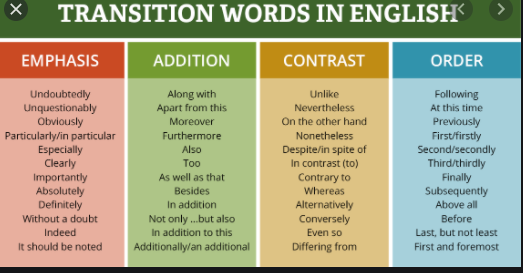
Look at the picture above. Review these terms. These are some of the words you will be using.

In addtion, other directions include: in front of, behind, above, rectangular, triangualar, divided by, right, left, cardinal directions -eg. northeast corner, or clock times for direction- eg: the left hand is at 4 o'clock. And of course, there are the simple object directions, such as tree or house. 

The images will only be on the board. Not on the blog. 

Have fun. This is a simple 100 point bonus. That means, if you are missing one of the class assignments, you may substitute this. However, if you turn around before time is called, this opportunit y is forfeited.


Tuesday, October 5, 2021

Wed/Thur, Oct 6/7 writing reflection on prejudice.


A preconceived opinion that is not based on reason or actual experience

Some of the most well-known types of prejudice include:

1.Racism -prejudice, discrimination, or antagonism directed against a person or people on the basis of their membership in a particular racial or ethnic group, typically one that is a minority or marginalized.

2.. Sexism-prejudice, stereotyping, or discrimination, typically against women, on the basis of sex.

3. Ageism-refers to negative discriminatory practices against old people, people in their middle years, teenagers and children.

4. Classism-prejudice against or in favor of people belonging to a particular social class

5.  Homophobia-dislike of or prejudice against gay people

6. Nationalism-identification with one's own nation and support for its interests, especially to the exclusion or detriment of the interests of other nations.

7. Religious prejudice.-note that prejudice  towards Jews is called anti-Semitism and prejudice  towards Muslims is called Islamophobia

8.  Xenophobia.- fear of foreigners or other cultures

9. Physical ableism is hate or discrimination based on a person's physical appearance. Mental ableism is discrimination based on mental health conditions and cognitive differences.

In class: written reflection on a prejudice and discrimination.
         Two paragraphs. Minimum of 250 words total (more is welcomed)

               Due by 6 pm Thursday, October 7  You have classtime Wednesday/ Thursday.

                You will receive two writing grades: one for content and one for language conventions. That is spelling, capitalization and punctuation.

                Make sure to proof read. One of the most effectiv ways is to read your work aloud-even if it is only in your head.

As this is your first formal writing, you will create a google doc following the correct MLA format.            
                                            
Directions:  To begin. You must use a correct MLA heading remember that the work is always double-spaced)
                     Your name
                     Instructor name
                     English II- ( ),  Discrimination
                     Date: 7 October 2021


Please note carefully the international date format. There is no punctuation. This goes on the top left of your document.
                       Use Times New Roman font
                        Size 12


Remember to give me persmission. Check the sharing.
             
From the list above, select one type of prejudice
                     Paragraph one

                    1. You will begin with a hook sentence to grab the
                         reader and introduce your theme or central
                         idea, which is prejudice and discrimination.

(consider a generic / general statement about what prejudice is and how the harm affects or impacts society and individuals.)

                    2.  In your next sentence you will narrow down to 
                          your chosen topic. Read the definition; then put 
                          this in your own  words; paraphrase what that  
                          means. 

                    3. Conclude this paragraph by responding in general
                         terms to the impact of this prejudice. Think who,
                         what.

                     Paragraph 2
                     1.  YOU NEED to transition* into your next  
                          paragraph to focus on two potential scenarios or 
                          situations where someone might experience 
                          discrimination. Consider social, economic,
                          political or educational. This is a short writing 
                          assignment, so choose only two and write a 
                          succint (clear and to the point) example.

                      2. Your last one or two sentences should be a 
                          statement on what happens when one is not 
                          prejudice. This will depend upon your topic 
                          choice.
                          
*


Make sure to proof read! I suggest strongly that you read what your wrote aloud. Capitalization? Correct Punctuation? Spelling? 

You will not need to use "I think, I believe" or any other iteration of these words. You make a statement. You are supporting this. 

Avoid it! When you want to use this pronoun, select a synonym. 

Any time you start your sentence with If (I, he, she, they), use were. If takes the subjunctive tense.

Tuesday, October 5 Counselors and PSAT


The counselors are here today.

Are you missing assignments? I am avaiable for assistance periods 6, 7, 8.

Monday, October 4, 2021

Monday, October 4: culmination of material on America by Claude McKay.


In class: today you are independently completing a graphic organizer on Claude McKay's America that has been chunked, so as you are able to respond to specific lines in the sonnet. There is nothing new here. We have covered the everyone of the topics within the organizer.  This is due at the close of class, unless you receive extended time.

Note: this will count as a writing grade.

Remember that the counsellors will be coming in tomorrow.

Missing an assignment? Please check the blog. Everything we cover in class is here.


America by Claude McKay

1. Although she feeds me bread of bitterness

1. What is being personified in line one and is referred to as “she”


2. Explain the metaphor “bread of bitterness”

After you have answered a and b


a. what is bread supposed to be for?


b. Is “bitterness” sweet or tart?

Now return to number 2.

And sinks into my throat her tiger’s tooth,

3. What does the visual imagery of a “tiger’s tooth tell us about the author’s feelings towards the city?


Stealing my breath of life, I will confess

4. Underline the word that LEAST reflects “stealing my breath of life”? 


smother,  choke,  asphyxiate,  inspiring

I love this cultured hell that tests my youth.

5. Think of the setting of the sonnet.

Explain “cultured hell”


5. Her vigor flows like tides into my blood,

6. vigor is power (think vigorous). Now think about what tides are like and explain the simile “like tides into my blood”


Giving me strength erect against her hate,

7. Who / what is the author accusing of hate?


Her bigness sweeps my being like a flood.


Yet, as a rebel fronts a king in state,

8. What might the author mean when speaking about “her bigness”?


9. Note the simile “like a flood”. Look back into line 5. What word indicates the power of a flood?   

I stand within her walls with not a shred


10. Of terror, malice, not a word of jeer.

10. Which word best defines

a.     terror:  dread   confidence   courage

b.     malice:  love     contempt      amity

c.      jeer:       cheer   applause       sneer

And see her might and granite wonders there

11. To what do “granite wonders” refer?


Beneath the touch of Time’s unerring hand,

12. Why do you think “Time” is capitalized?


13.  What literary device is being used here?


14. To err means to make a mistake? What does “unerring” mean”?


Like priceless treasures sinking in the sand.


15. The sonnet ends with a smile (like), comparing “priceless treasures sinking in the sand.”

What is the author’s tone, which is the literary term for attitude, towards the city?

Answer this in a complete sentence.


Thursday, September 30, 2021

Friday, October : imagery practice


In class: Everyone will receive a handout, and everyone with complete an individual handout. However, you will work together to determine the types of imagery used and examples from the text to support your selection.

This is due at the close of class.

For anyone who is absent, please copy and paste the following onto a google document, complete and share with me. Make sure you have given me share rights.

dorothy.parker@rcsdk12.org

Part 1

Group practice: For each of the following identify the type of imagery: seeing /visual,     hearing/auditory, smelling/ olfactory, tasting/ gustatory, or feeling/ sensory.


1.       In the hard-packed dirt of the midway, after the glaring lights are out and the people have gone to bed, you will find a veritable treasure of popcorn fragments, frozen custard dribblings, candied apples abandoned by tired children, sugar fluff crystals, salted almonds, popsicles, partially gnawed ice cream cones and wooden sticks of lollipops.   from Charlotte's Web by E.B. White

The type of imagery used is _____________________________.

Examples from the text that support this are: (insert examples)   ___________________________________________________________________________

 ____________________________________________________________________________

____________________________________________________________________________

2.       In the period of which we speak, there reigned in the cities a stench barely conceivable to us modern men and women. The streets stank of manure, the courtyards of urine, the stairwells stank of moldering wood and rat droppings, the kitchens of spoiled cabbage and mutton fat; the unaired parlors stank of stale dust, the bedrooms of greasy sheets, damp featherbeds, and the pungently sweet aroma of chamber pots.   Patrick Suskind's novel, Perfume: The Story of a Murderer


The type of imagery used is __________________________


Examples from the text that support this are: (insert examples)   _____________________________________

 __________________________________________________________________________________

_______________________________________________________________________________


3.       On rainy afternoons, embroidering with a group of friends on the begonia porch, she would lose the thread of the conversation and a tear of nostalgia would salt her palate when she saw the strips of damp earth and the piles of mud that the earthworms had pushed up in the garden. Gabriel Garcia Marquez One Hundred Years of Solitude

The type of imagery used is ____________________________________

Examples from the text that support this are: (insert examples)_________________________________________________________

_________________________________________________________________________________________

4.       It commenced rainin one day an did not stop for two months. We went thru ever different kind of rain they is, cep'n maybe sleet or hail. It was little stingin rain sometimes, an big ole fat rain at others. It came sidewise an straight down an sometimes even seem to come up from the groun.    Forest Gump by Winston Groom


The type of imagery used is ____________________________________

Examples from the text that support this are: (insert examples)  _________________________________________________________

_____________________________________________________________________________

___________________________________________________________________________

5.       Now small fowls flew screaming over the yet yawning gulf; a sullen white surf beat against its steep sides; then all collapsed, and the great shroud of the sea rolled on as it rolled five thousand years ago. Herman Melville Moby Dick

 The type of imagery used is ____________________________________

Examples from the text that support this are: (insert examples)_________________________________________________________

_________________________________________________________________

__________________________________________________

Part 2 

Group practice. For each of the following sentences, identify the imagery is 1) seeing/ visual, 2) hearing/ auditory, 3) smelling/olfactory, 4) tasting/ gustatory 5) touch/ tactile


1.     The eerie silence was shattered by her scream.                                      _______________________

2.     Her face blossomed when she caught a glance of him.                          _______________________

3.     He could hear his world crashing, when he heard the news.                 _______________________

4.     She was like a breath of fresh air infusing life back into him.              ________________________

5.     The concert was so loud that her ears rang for days afterward.            ________________________

6.     The deep yellow hues of the sunset drowned in and mixed with the blues of the sea.____________

7.     ­­ Mommy hauled her little baby up in the air, placed him on the bed and prodded her fingers in his squishy skin eliciting fits of belly-laughs.  _____________________

8.     Brown horned gazelle meandered about the tall grass blinking away the following flies; cushioned paws didn’t make sound and the gazelle didn’t know the danger lurking

behind it.  ______________

9.     Ja’Nae didn’t have to wait for the clock to strike 2, her mother stormed out of her room, slamming the door behind her and glaring at her daughter, daggers in her eyes._____________

10.  The wings of the fan curved like a dog’s ears waggled with a raucous squeak at a speed that the air couldn’t reach the one sitting under it._____________


Friday-Tues, Jan 7-11 Story of an Hour (zoom) accompanying organizer

    Please join your class zoom meeting at the correct time. You must log in to receive attendance credit for the day.    Dorothy.Parker@RCS...